


 ScriniAI agents that hire for every role
 Job seekers
 Recruiters
Using ai for high volume hiring without resume overload
A practical guide on deploying conversational AI agents to screen mass applications, enforce structured rubrics, and protect recruiter time.
In this article
- Key takeaways
- Why manual screening breaks in high volume recruiting
- How does AI screening help with high-volume hiring?
- How do you speed up high-volume hiring without sacrificing candidate quality?
- Funnel economics: a worked screening math example
- How Scrini AI supports high-volume pipelines
- Frequently asked questions
- Next steps for your hiring pipeline
AI for high volume hiring automates repetitive early screening steps so talent teams focus only on qualified applicants. Conversational agents reach candidates within minutes, confirm shift availability, and run structured initial interviews before handing scored profiles to human hiring managers. This filters bot applications and speeds up time to screen while humans retain every hiring decision.
Key takeaways
- Deploy two-way conversational screening across voice and SMS to quickly separate serious applicants from bot-generated submissions.
- Lock down objective, structured scoring rubrics before screening starts to limit interviewer drift across high volumes.
- Automate early scheduling so qualified candidates book straight into hiring manager calendars without multi-day email lags.
- Keep humans firmly in control by using AI solely for first-round evaluation and evidence collection.
Why manual screening breaks in high volume recruiting
Candidate application volumes have surged because generative AI makes it easy for job seekers to blast hundreds of generic resumes across job boards. Industry experts note the hiring funnel has split into two distinct pathways, separating human applicants from candidate bots. Static applicant tracking systems try to manage this influx with blunt keyword filters. Yet 88 percent of employers agree that qualified high-skills candidates get vetted out because they do not match exact job description criteria.
These traditional filters look backward at resumes instead of assessing real-time intent or core competencies. Recruiters spend hours scanning text files instead of talking to promising talent. Industry analysis suggests that as much as 95 percent of early-funnel activity can eventually run on automated systems. Without interactive screening tools, recruiting teams spend hours on manual triage while qualified candidates abandon slow hiring funnels. You can scale hiring without scaling teams by rethinking early funnel operations.
How does AI screening help with high-volume hiring?
AI screening helps with high-volume hiring by contacting applicants within minutes, verifying basic requirements through two-way voice or text conversations, and conducting structured preliminary interviews. This filters out automated applications, scores real candidate responses against a set rubric, and delivers verified profiles to human recruiters for final hiring choices.
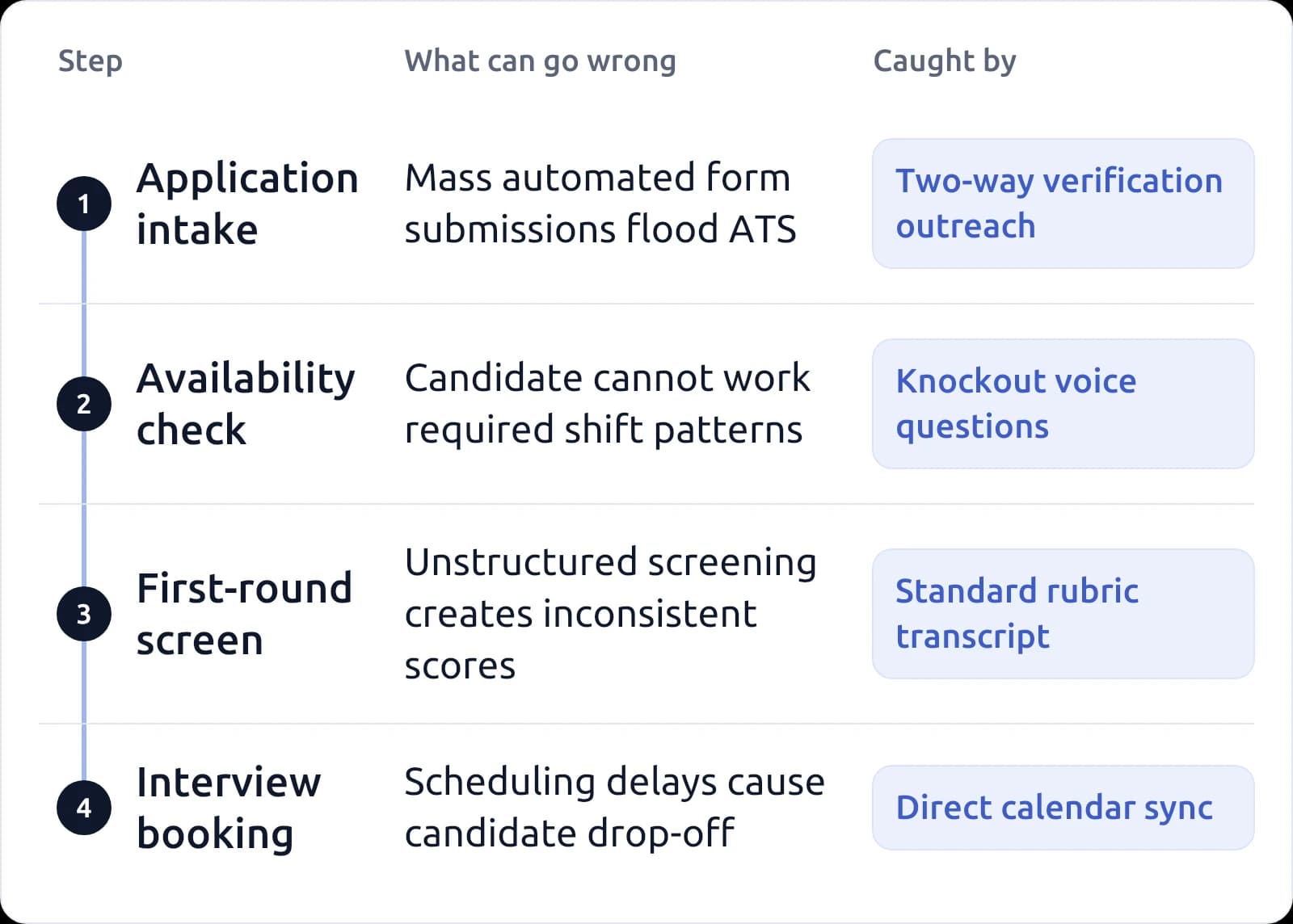
Modern conversational agents engage applicants across SMS, voice calls, and video around the clock. Instead of waiting days for an email response, applicants complete a brief qualification session right after applying. Agents collect answers to knockout questions like shift availability, commute limits, or required certifications.
During these interactions, the system asks standardized questions and captures spoken evidence. The platform evaluates responses against a locked rubric, transcribing answers and compiling structured scorecards. Human recruiters can then review transcripts, inspect objective scores, and advance qualified applicants without chasing them by phone. Learn more about running an outreach agent that never stops engaging top applicants.
How do you speed up high-volume hiring without sacrificing candidate quality?
You speed up high-volume hiring without sacrificing quality by replacing resume scans with objective, structured rubrics and adaptive conversational screening. Two-way agents present realistic workplace scenarios, like handling an upset customer or an unexpected weekend shift change, before booking interviews. This standardized evaluation limits recruiter bias and identifies capable candidates who lack keyword-optimized resumes.
Structured rubrics hold every candidate to identical evaluation criteria. When screening agents ask follow-up questions based on applicant answers, they gather deeper evidence than any resume summary provides.
| Screening Stage | Traditional Manual Screening | Conversational AI Screening |
|---|---|---|
| Initial response time | Two to seven business days via email | Minutes after application via voice or SMS |
| Applicant qualification | Static keyword filtering on past resume text | Interactive verification of shifts, licenses, and skills |
| Scoring consistency | Subjective recruiter notes with high drift | Standardized rubrics with verbatim transcripts |
| Scheduling handoff | Multiple emails back and forth to find open slots | Direct calendar booking for qualified applicants |
This process protects standards across thousands of applicants. Human hiring managers receive pre-vetted profiles complete with objective ratings and audio or text transcripts. You can review how AI video agents evaluate candidates fairly across large candidate pools.
Funnel economics: a worked screening math example
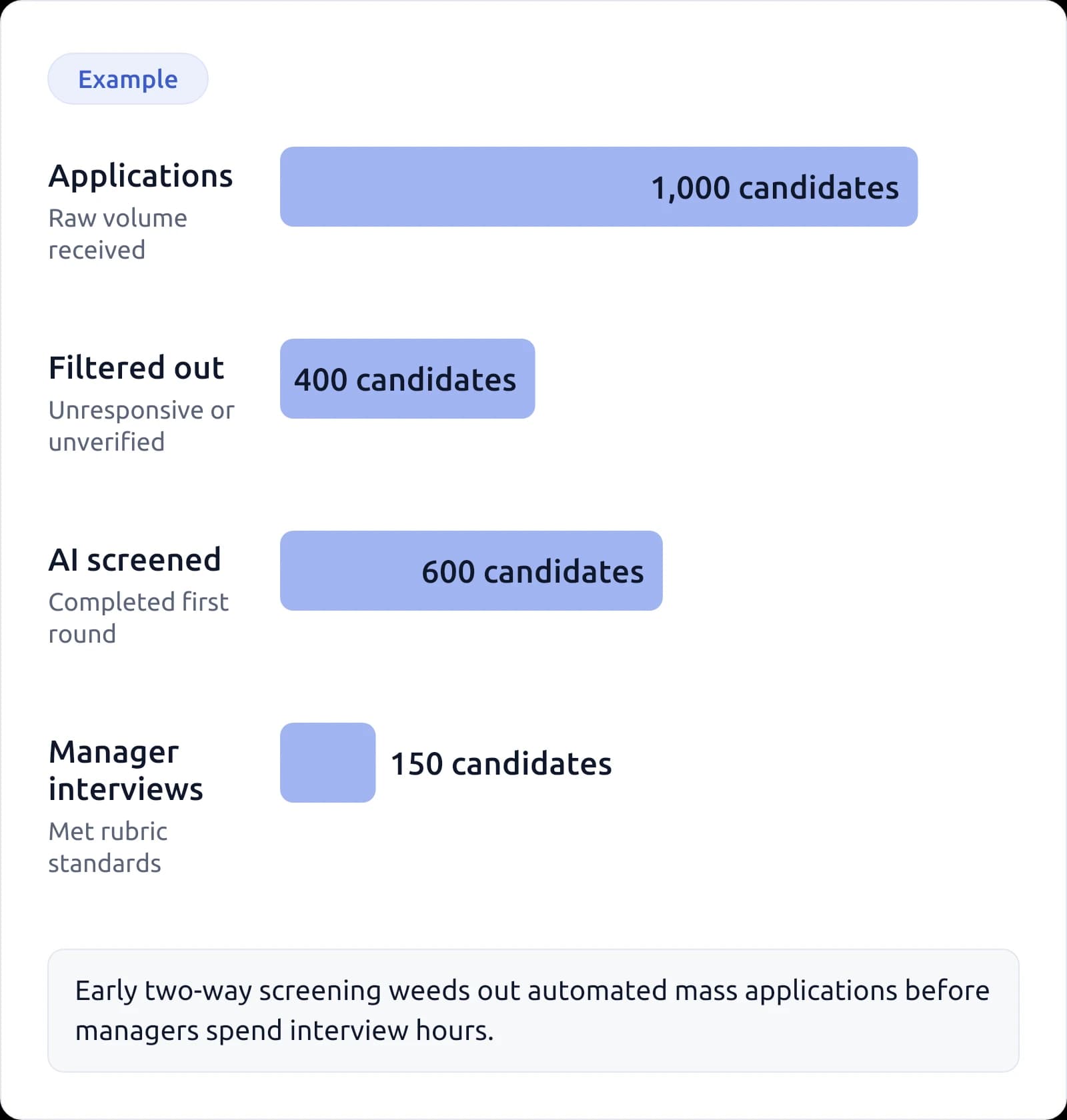
Standard high-volume funnels lose massive recruiter capacity on applicants who never pick up the phone or fail basic qualifications. Introducing interactive conversational screening concentrates human recruiter time on the most promising candidates.
Example: Consider a high-volume customer service role that attracts 1,000 raw applications over a month. Under an automated model, conversational agents reach out to all 1,000 applicants within five minutes. Roughly 400 applicants fail to respond or disqualify themselves based on non-negotiable shift requirements. The remaining 600 complete an interactive screening interview. The rubric flags the top 150 qualified candidates, who book directly onto hiring manager calendars. Recruiters spend zero hours screening resumes and spend all their allocated time conducting final interviews with verified candidates.
How Scrini AI supports high-volume pipelines
Scrini AI delivers agentic recruiting workflows that reach out to applicants in minutes, screen for schedule availability, and book interviews directly into manager calendars. The platform conducts structured initial interviews, gathering clear evidence and scoring responses against unified rubrics for your hiring team to evaluate. You can access continuous analytics covering sourcing, candidate screening, interviews, and overall pipeline velocity.
The platform operates on a transparent credit model rather than per-seat software licenses. On the Startup tier, usage credits cost US$0.10 each, meaning you pay only for completed screening interactions without user subscription fees. New teams can test the system with 100 free credits and no credit card required. Connecting your applicant tracking system takes under two hours, and most teams are fully operational within 24 to 48 hours.
Frequently asked questions
Will AI screening agents replace human recruiters?
No, conversational agents do not replace recruiters. The technology handles repetitive initial tasks like verifying schedules, confirming basic qualifications, and gathering structured interview responses. Human hiring managers review complete transcripts, evaluate rubric scores, conduct final interviews, and make every ultimate hiring decision.
Do job candidates trust AI-driven screening?
Candidate trust depends on transparency and system boundaries. Research shows 66 percent of Americans prefer not to apply if AI helps make hiring decisions, while 70 percent oppose face recognition to analyze expressions. Compliant platforms inform candidates that an agent is speaking and evaluate spoken answers against job rubrics without facial analysis.
How do automated screening tools maintain legal compliance?
Compliance requires algorithmic transparency and audit trails. State regulations like the Colorado AI Act, which takes effect on June 30, 2026, mandate reasonable care to prevent algorithmic discrimination in high-risk employment systems. Using fixed, job-related rubrics and keeping humans in charge of final hiring decisions helps teams maintain defensible, compliant processes.
What is the difference between time to screen and time to hire?
Time to screen measures the speed of verifying baseline qualifications, whereas time to hire covers the entire cycle to a signed offer. Automated screening compresses early evaluation from days to minutes. This acceleration shortens the overall time to hire while freeing recruiters to focus on candidate engagement.
Next steps for your hiring pipeline
Start upgrading your high-volume hiring workflow with three practical steps this week:
- Audit applicant tracking system timestamp logs to calculate median drop-off hours between initial application submission and first candidate response.
- Document five non-negotiable qualification criteria, such as shifts, licenses, or commute distances, for your highest-volume open role.
- Build an objective five-point scoring rubric with concrete answer guidelines to replace subjective resume scanning.