


 ScriniAI agents that hire for every role
 Job seekers
 Recruiters
how to detect ai resumes without flawed detector tools
To detect AI resumes accurately, stop using unreliable text classifiers and start testing for authentic, role-specific evidence. Candidates use generative tools...
In this article
- Key takeaways
- Can ATS detect AI resumes automatically?
- How can recruiters tell harmless polish from candidate fraud?
- What are the linguistic red flags in AI-generated resumes?
- A worked verification example: high-volume intake triage
- How automated first-round screening protects candidate quality
- Frequently asked questions
- Audit your candidate verification this week
To detect AI resumes accurately, stop using unreliable text classifiers and start testing for authentic, role-specific evidence. Candidates use generative tools to polish formatting or invent entire career histories. Spot the difference by pairing linguistic teardowns with fast, evidence-based initial screening workflows. Learn how to detect AI resumes by replacing guesswork with clear, structured proof.
Key takeaways
- Differentiate benign wording adjustments from outright identity and timeline fabrication.
- Bypass probabilistic AI text checkers that produce high false-positive rates.
- Inspect structural markers like identical bullet lengths and vague high-status verbs.
- Deploy multi-channel initial verification screens to validate actual candidate capability.
- Retain human recruiters for every shortlisting and hiring decision.
Can ATS detect AI resumes automatically?
Standard applicant tracking systems cannot spot machine-generated text. ATS software parses files, extracts plain text, and matches keywords against job descriptions. It evaluates whether specific terms and work histories match a role, not whether a human or a language model wrote the sentences.
Hiring teams often assume their systems run automated authenticity checks on inbound files. In reality, traditional parsing software looks only for specific skills, dates, and job titles. When candidate software inserts keywords to match a job post, the parser simply scores the document higher.
Commercial AI text classifiers can create operational headaches for employers trying to evaluate applicants fairly. Federal regulators intervened when an order settled allegations against Workado for advertising its detector as “98 percent” accurate. Teams avoid unreliable scanners by following structured hiring guides that emphasize evidence-based evaluations.
How can recruiters tell harmless polish from candidate fraud?
Recruiters distinguish harmless polish from candidate fraud by verifying factual records rather than evaluating writing tone. Harmless polish improves phrasing, fixes syntax, and organizes existing achievements. Fraud introduces fabricated credentials, invented employers, hidden keyword blocks, and unearned technical skills. Teams must cross-reference verifiable milestones instead of penalizing clean grammar.
Job seekers can easily alter their credentials using generative software. Surveys show that 73 percent of candidates would consider using automated tools to embellish or lie on their resumes. AI agents handle repetitive first-round phone screens to evaluate practical skills, while human recruiters make the final hiring decisions.
Evaluating every candidate on word choice alone creates bias against non-native speakers who use software to polish their phrasing. The real risk lies in fictional work history, bot-driven mass submissions, and altered timelines.
| Candidate action | Intent and impact | Verification action | Credibility risk |
|---|---|---|---|
| Formatting and syntax edits | Cleans grammar and organizes clear work history | Confirm timeline details during initial recruiter conversation | Low |
| Keyword stuffing | Matches parsing filters using invisible or repeated text | Review source text formatting and inspect file metadata | Medium |
| Fabricated titles and credentials | Invents past employers, degrees, or unearned responsibilities | Cross-check external employment records and conduct role-specific tests | High |
| Automated bot application spam | Submits thousands of auto-generated profiles across open roles | Require interactive multi-channel responses during first-round intake | Critical |
What are the linguistic red flags in AI-generated resumes?
Linguistic red flags in AI resumes center on structural uniformity and vague language. Generated drafts rely on identical sentence lengths, repetitive bullet points, and abstract verbs like spearheaded without concrete business outcomes. Unedited drafts also contain dead giveaways, such as unresolved prompt placeholders or identical transitional phrases across unrelated roles.
Human resumes contain natural variation. People use irregular sentence lengths, industry shorthand, and specific internal project names. Generic models produce predictable patterns:
- Uniform bullet architecture: Large language models generate bullet points of nearly identical character counts across every entry.
- Inflated verbs without context: Sentences lean heavily on terms like spearheaded, orchestrated, or maximized without stating project scope, team size, or concrete figures.
- Monotonous clause structure: Every bullet begins with an action verb, follows with an abstract task, and closes with a vague claim of business success.
- Unedited prompt artifacts: In severe cases of unvetted copying, candidates leave text like "insert metrics here" or introductory chat phrases inside the document.
A worked verification example: high-volume intake triage
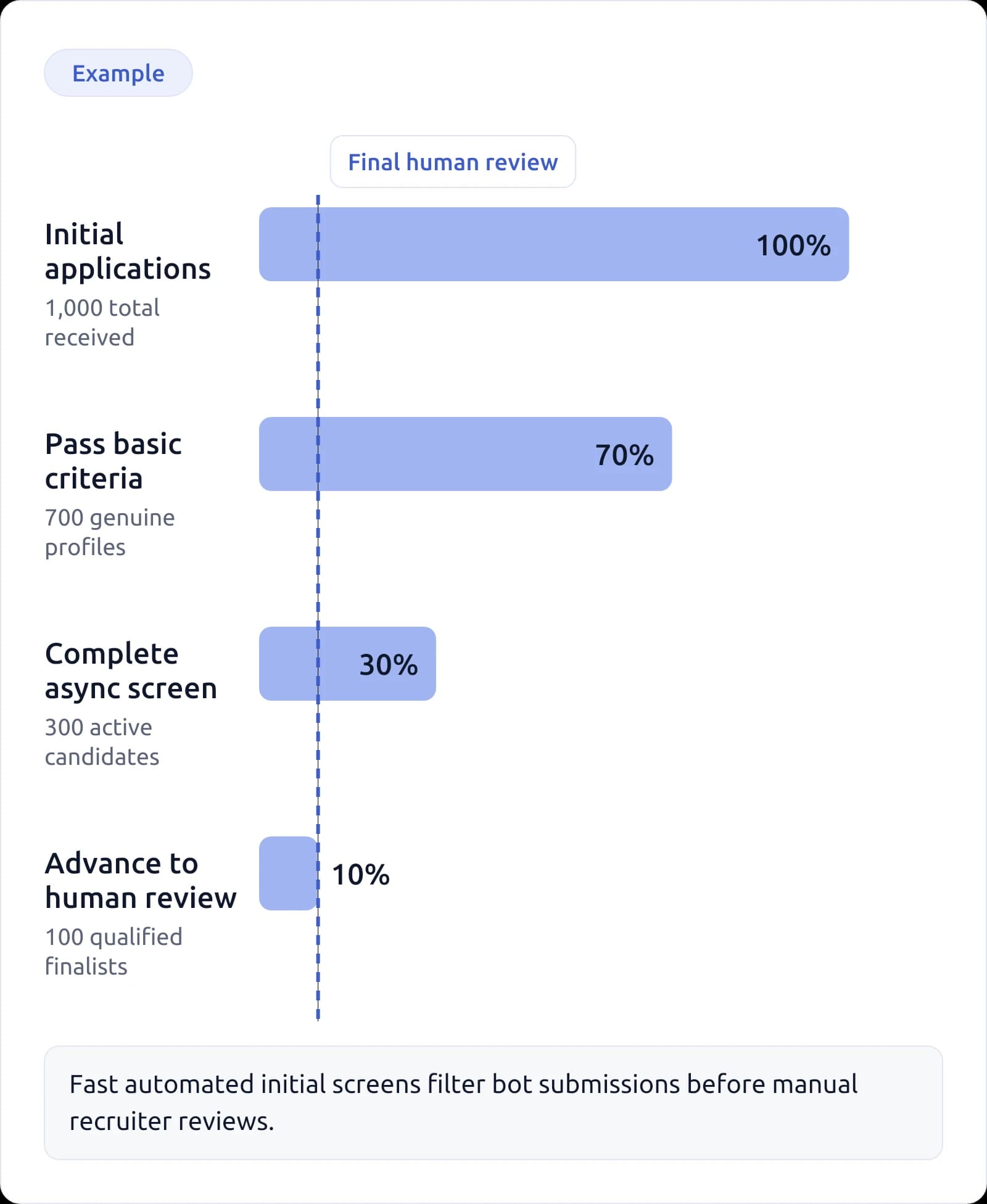
Example: A regional logistics company posts an opening for an entry-level customer service specialist and receives 1,000 inbound applications within two days. Manual reviews choke your pipeline, while statistical text checkers discard viable applicants.
Instead of trusting resume text alone, the team routes all 1,000 applicants through an automated phone verification step. About 300 resumes showed suspicious linguistic patterns, such as repetitive syntax and missing project details. The system initiates rapid phone outreach to ask basic qualification questions, including shift availability, software familiarity, and a brief response to a customer conflict scenario.
Out of the 1,000 submissions, 400 applicants fail to answer or disconnect right away, confirming mass bot activity. Another 300 applicants decline the availability requirements or provide non-responsive answers. Of the remaining 300 applicants who complete the screen, the system scores their practical answers against the role rubric. Recruiters receive 100 qualified, verified candidates with full audio recordings and transcripts ready for human evaluation. Teams learn to configure standardized workflows for volume roles.
How automated first-round screening protects candidate quality
Relying on resume paper reviews alone leaves recruiting pipelines vulnerable to generative manipulation. Modern teams configure standardized workflows for volume roles. Instead of reading every line of text, talent teams let AI handle the repetitive intake while recruiters and hiring managers review, override, and decide on every final selection.
Scrini AI coordinates the first round of hiring, covering candidate outreach, initial phone screens, structured video assessments, and rubric rankings. AI agents call every applicant in minutes to verify basic criteria. During these conversations, agents screen for availability, location, and customer-facing scenarios before booking interviews straight into manager calendars.
Candidate responses are transcribed and scored against the rubric, with audio and text kept as verifiable evidence for each score. Recruiters use this objective evidence to decide who moves forward, helping to multiply recruiter output and automate the hiring workflow.
Organizations pay only for completed screening work through flexible usage credits, avoiding rigid per-seat licensing fees. The Startup plan starts with 100 free credits with no card needed, and additional credits cost US$0.10 each.
Frequently asked questions
Do recruiters automatically reject resumes written with ChatGPT?
Recruiters do not automatically reject resumes simply because an applicant used ChatGPT. Most talent teams welcome generative tools for basic grammar corrections, formatting clarity, and concise bullet points. Rejections happen when candidates use generative software to invent unearned technical skills, fabricate employment timelines, or submit generic applications across hundreds of unrelated roles.
How to detect AI resumes without using flawed text detectors?
To detect AI resumes without text detectors, cross-reference document claims against interactive verification screens. Look for linguistic tells like repetitive bullet lengths and high-level verbs lacking metrics. Then, deploy brief automated phone or video questions to confirm whether the applicant can explain their stated achievements in their own words.
Why do commercial AI text detectors fail on resumes?
Commercial text detectors fail on resumes because professional documents naturally follow predictable, formal patterns. Generative classifiers rely on perplexity and burstiness metrics, which misclassify structured professional writing as machine text. These tools produce high rates of false positives, unfairly penalizing qualified job seekers and non-native speakers who write in formal language.
Do candidates accept AI making hiring decisions?
Candidates overwhelmingly reject artificial intelligence making final employment choices. In a public opinion survey, 71% opposed employers using AI to make final hiring decisions, while only 7% supported it. Job seekers accept automated systems that schedule interviews or conduct initial screening calls, provided human recruiters review the evidence and make the final choice.
Audit your candidate verification this week
Review the last fifty rejected resumes in your applicant tracking system this week. If your team relies on automated text classifiers, remove those filters from your candidate pipeline right away. Replace theoretical text detection with two mandatory knockout questions in your application form: one asking for a specific, metric-backed project result and another confirming shift availability. Then, set up an interactive initial phone screen for qualified applicants. Interactive screening calls deliver scorecards and audio proof so recruiters can advance honest talent fast.