


 ScriniAI agents that hire for every role
 Job seekers
 Recruiters
How to reduce time to hire with AI
A tactical playbook for cutting candidate screening timelines from weeks to days using calibrated AI rubrics, automated verification, and structured manager handoffs.
In this article
- Key takeaways
- What is the difference between time to hire and time to fill?
- Where does candidate screening lose the most time?
- How can AI reduce time-to-hire?
- How to build calibrated rubrics for automated screening
- Example: compressing a thirty-day screening funnel
- Automating candidate screening with Scrini AI
- Frequently asked questions
- Next steps for your hiring pipeline
You can reduce time to hire with AI by automating initial qualification checks, conversational screening, and interview scheduling the moment an application arrives. AI agents review basic credentials and ask role-specific questions without delay, passing structured scorecards to hiring managers while humans retain final decision authority. This process shortens first-round screening from several weeks to a few days.
Key takeaways
- Separate candidate velocity from requisition duration to fix operational screening delays.
- Calibrate objective AI screening rubrics based on verifiable credentials, shifts, and required skills.
- Automate async first-round screening to evaluate candidates the same day they apply.
- Deliver evidence-backed scorecards so hiring managers review candidate transcripts and qualification scores within hours.
- Keep human decision-makers in charge while AI handles repetitive administrative scheduling and triage.
What is the difference between time to hire and time to fill?
Time to hire measures candidate velocity, tracking the days between an applicant submitting their resume and accepting an offer. Time to fill tracks the total duration a job requisition stays open from approval to hire. Conflating the two metrics hides operational bottlenecks during early resume triage.
According to industry benchmarks, time to fill for nonexecutive roles has dropped to a median of 39 calendar days. Meanwhile, professional services organizations face an extended candidate timeline, averaging an average of 47 days from application to acceptance. As outlined in standard recruiting glossary definitions, keeping requisitions open for backfills differs from the speed at which active applicants move through the pipeline. When candidate screening drags on, top talent drops out.
| Metric | What it measures | Primary driver | Operational focus |
|---|---|---|---|
| Time to hire | Candidate velocity from initial application to signed offer | Screening speed, interview turnaround, offer negotiation | Candidate experience and fast recruiter response |
| Time to fill | Requisition duration from job opening to accepted offer | Sourcing volume, headcount approval, notice periods | Resource allocation and workforce planning |
| Screening lag | Delay between application submission and first conversation | Recruiter inbox capacity, manual resume review | Automated triage and prompt candidate engagement |
Where does candidate screening lose the most time?
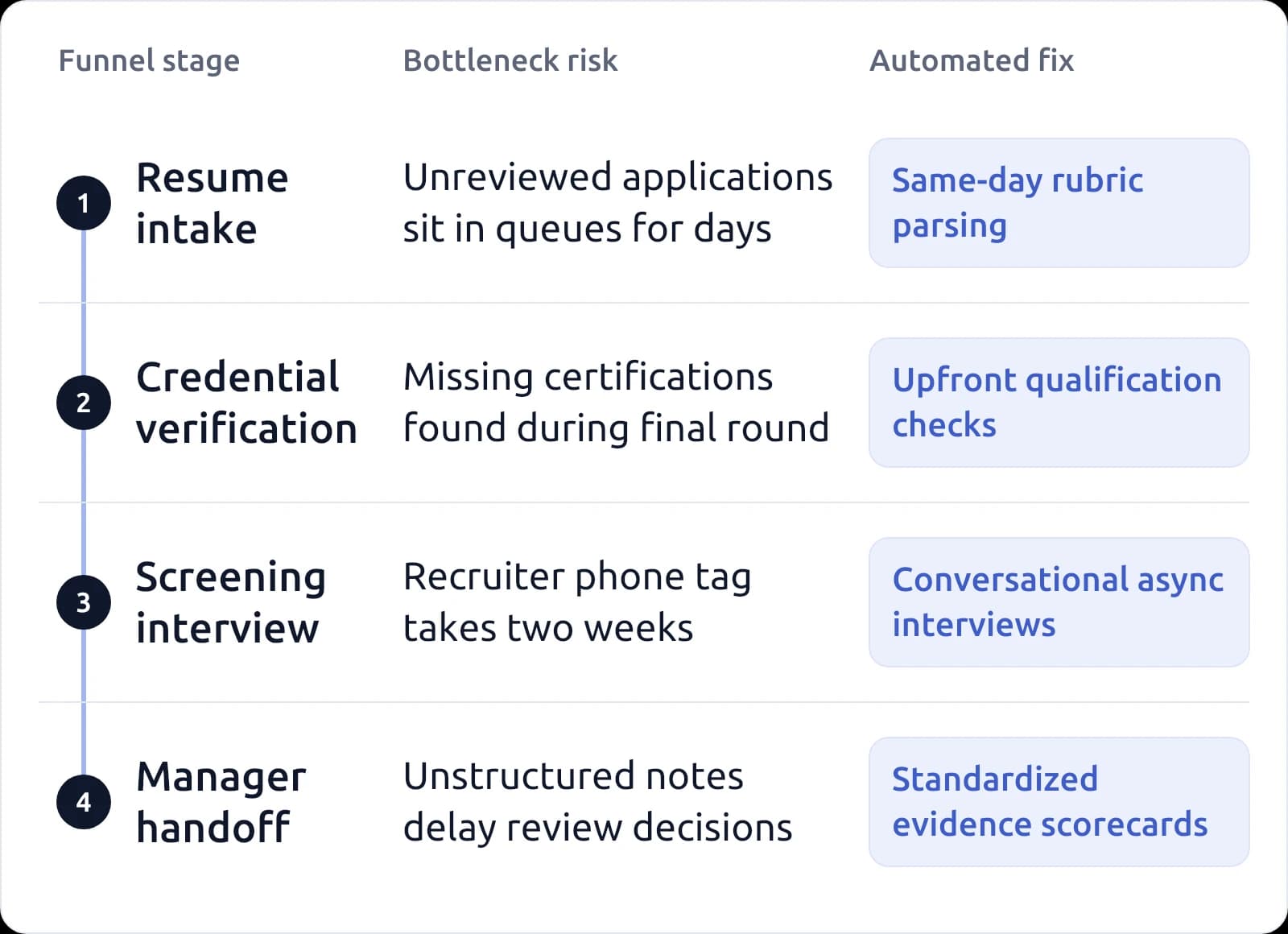
Candidate screening loses the most time during manual resume triage and asynchronous interview scheduling. Unopened applications linger in applicant tracking systems for days waiting for initial recruiter triage. Meanwhile, basic credential checks for certifications or shifts often happen weeks into the process instead of at the first touchpoint.
As detailed in structured hiring guides, traditional top-of-funnel workflows introduce friction across several steps:
- Manual resume sorting: Recruiters spend hours scanning resumes against basic role criteria, creating a multi-day queue before high-potential applicants receive any response.
- Credential discovery delays: Critical prerequisites like professional licenses, shift availability, and software proficiency surface late in phone interviews rather than during initial intake.
- Scheduling back-and-forth: Coordinating calendars across time zones via email adds several days between initial interest and the first substantive evaluation.
How can AI reduce time-to-hire?
AI reduces time to hire by handling high-volume initial engagement, prerequisite screening, and interview scheduling around the clock. Automated agents conduct conversational intake interviews, verify core requirements against structured rubrics, and generate objective candidate scorecards. Human hiring managers then review evidence-backed summaries to make informed interview decisions.
AI agents act as operational assistants rather than hiring authorities. They do not make hiring or rejection calls autonomously. Instead, they contact candidates through multi-channel outreach such as SMS and web chat within minutes of applying. They ask the exact questions a recruiter would ask during an initial phone screen.
Candidates complete these interactions on their own schedule. The agent records transcripts, checks licenses or shift compatibility, and populates the applicant tracking system with consistent evaluation rubrics. The hiring manager opens their dashboard, reviews candidate rankings and direct evidence, and decides whom to advance.
How to build calibrated rubrics for automated screening
To build calibrated rubrics for automated screening, define objective, binary minimum requirements followed by structured scoring tiers for core job competencies. An effective rubric strips out subjective bias, scores candidates strictly on demonstrable capabilities, and provides uniform evaluation criteria that an AI agent can execute consistently.
To set up an automated screening rubric, structure your criteria into clear layers:
- Define hard prerequisites: List non-negotiable items such as valid jurisdiction licenses, required work shifts, language fluency, and location constraints.
- Structure capability scales: Create clear rating definitions across performance levels for technical or situational competencies, complete with required conceptual criteria or behavioral evidence.
- Standardize question sequences: Ensure every candidate encounters the exact same questions under identical conditions to limit recruiter variance.
- Output transparent scorecards: Require the automated system to attach candidate quotes and completed task artifacts to every score point.
Example: compressing a thirty-day screening funnel
Compress your screening funnel by replacing manual intake reviews with automated conversational screens. When candidates complete prerequisite verification within hours of applying, recruiters avoid weeks of back-and-forth messaging. Hiring managers receive ranked candidate dossiers promptly, allowing them to advance qualified applicants to final interviews.
Example: A regional logistics company hiring for a fleet supervisor role previously lost qualified candidates while recruiters spent weeks manually screening applications and chasing schedule confirmations. Automated screening now invites applicants to complete brief assessments the day they apply, checking credentials and qualifications early. The system delivers structured, evidence-based scorecards directly to hiring managers, who quickly evaluate qualified finalists and make all final interview choices.
Automating candidate screening with Scrini AI
Scrini AI automates top-of-funnel hiring workflows by executing real-time applicant screening, technical assessments, and interview scheduling directly inside your existing recruitment stack. AI agents gather verifiable candidate data, score submissions against standardized rubrics, and deliver structured evaluation dossiers so hiring managers can focus purely on final selection.
The platform allows recruiting teams to open roles and pull ranked candidate profiles with transcripts, scores, and task results directly from their primary systems. Recruiters gain access to real-time analytics across sourcing and screening, tracking stage-by-stage conversions without manual data entry.
Integration is straightforward. In practice, most teams are live within 24 to 48 hours, connecting an applicant tracking system in under two hours with guided onboarding at no extra cost. Teams can monitor every stage through a centralized pipeline dashboard.
Billing is based on actual usage rather than per-seat licensing fees. Under the Startup plan, credits cost US$0.10 each, and new accounts begin with 100 free credits with no card needed. Organizations pay only when screening work is completed, keeping hiring costs aligned with active volume.
Frequently asked questions
How to reduce time to hire with AI
AI reduces time to hire by conducting immediate candidate outreach, verifying minimum prerequisites, and scheduling interviews automatically. Instead of waiting days for manual recruiter reviews, applicants complete structured screening interactions within hours of applying. This operational acceleration shortens the early screening phase while preserving human decision-making for final hiring stages.
Does reducing hiring time with AI compromise candidate quality?
No, automated screening preserves candidate quality by applying consistent, objective rubrics to every applicant. Research indicates that structured workflows enable organizations to improve recruitment efficiency by lowering time-to-fill while boosting quality metrics. Human hiring managers receive deeper objective evidence, including transcripts and task scores, before conducting final interviews.
Can conversational AI conduct first-round screening interviews?
Yes, conversational AI agents can conduct structured first-round screening interviews via text or asynchronous voice. These agents ask role-specific questions, verify essential licenses, and confirm schedule availability across various shifts. They collect standardized responses and build candidate scorecards, leaving the final evaluation and selection decisions to human hiring managers.
What recruitment tasks should HR teams automate first?
HR teams should first automate resume triage, basic qualification checks, and interview scheduling. These administrative steps consume significant recruiter time and cause the longest delays in candidate communication. Automating top-of-funnel interactions ensures candidates receive prompt responses while recruiters focus their attention on high-value candidate engagement and final selection.
Next steps for your hiring pipeline
Audit your hiring pipeline this week to isolate operational drag. Calculate the average calendar days between when a candidate submits an application and when they complete their first interview. Then, write down key objective qualification criteria for your most active role, such as mandatory certifications or shift hours, to form the baseline of an automated screening rubric.