


 ScriniAI agents that hire for every role
 Job seekers
 Recruiters
AI for diversity in hiring: beyond resume filters
Traditional keyword filters reject qualified non-traditional talent. Here is how AI skills screening expands diverse talent pools objectively.

AI for diversity in hiring broadens candidate pools by replacing keyword-based resume screening with objective skill assessments. AI agents run practical work evaluations rather than judging candidates on pedigree or degree requirements. Human recruiters retain full authority over hiring decisions, using structured evidence instead of gut feel.
Key takeaways
- Traditional ATS filters screen out qualified applicants on degree requirements alone. That practice limits candidate pipelines early, since less than 40 percent of U.S. professionals hold a four-year degree. Automated screening and multi-channel outreach qualify candidates in minutes while human recruiters make the final hiring decisions.
- AI work simulations evaluate direct capabilities, letting non-traditional applicants prove job readiness.
- Regular adverse impact audits using the four-fifths rule ensure selection rates remain legally compliant.
- Human reviewers make all final hiring choices backed by objective, documented scorecards.
Why do traditional resume filters hurt diversity hiring?
Traditional resume filters hurt diversity hiring because they rely on rigid proxy metrics like pedigree, job titles, and university degrees. These automated filters favor candidates with conventional backgrounds rather than evaluating actual competence. By rejecting applicants whose resumes lack specific formatting or credentials, legacy systems exclude qualified, non-traditional talent before human recruiters ever see their applications.
Most applicant tracking systems parse text for formal education markers. Yet under 40 percent of U.S. professionals hold a four-year degree even though nearly 70 percent of job listings mandate one. This disconnect stalls hiring cycles for weeks and locks out experienced contributors who gained expertise through apprenticeships, military service, or community colleges.
Research shows that 44 percent of middle-skill hidden workers reported that securing employment was just as difficult before 2020 as during it. When organizations shift toward evaluating practical abilities, talent pipelines expand rapidly. Over two-thirds of credential-holders report that specialized certificates advanced their careers. Teams that assess skills rather than resumes use structured, consistent assessment data for their hiring decisions.
How does skills-based screening expand candidate pools?
Skills-based screening expands candidate pools by assessing what applicants can do today instead of where they worked previously. Automated agents administer role-specific tasks, observing problem-solving steps in real time. Paired with multi-channel candidate outreach across non-traditional networks, this evidence-based screening surfaces qualified talent that standard filters discard.
Evaluating practical ability helps employers overcome chronic labor constraints. Organizations that actively hire non-traditional workers report being 36 percent less likely to face talent shortages than peers that ignore these candidate pools. Instead of scanning static PDFs for keywords, modern evaluation platforms rely on pixel-native screen perception to observe how applicants solve realistic job tasks.
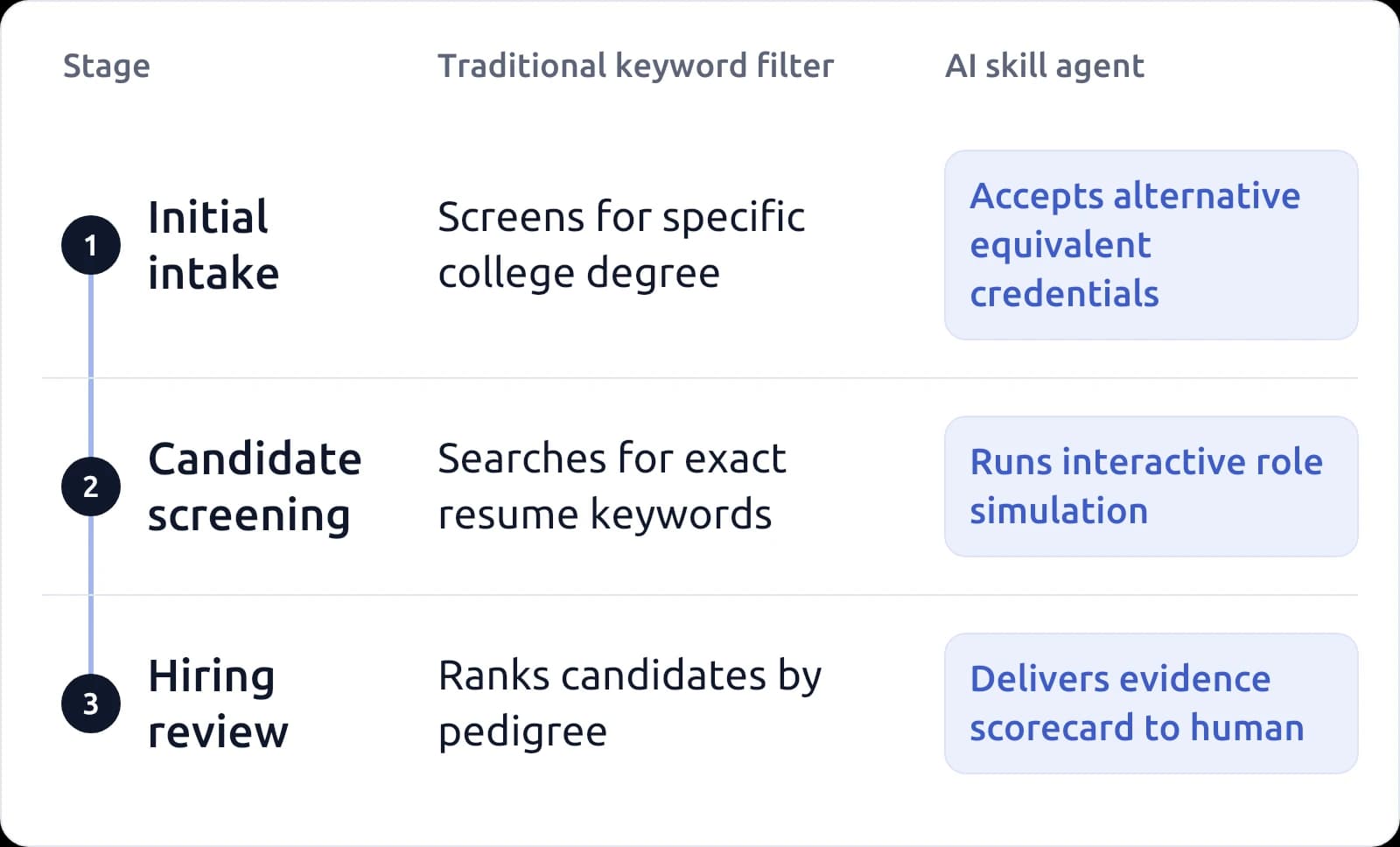
The table below contrasts static resume parsers with skills-based screening agents.
| Dimension | Legacy ATS keyword parser | AI skill assessment agent |
|---|---|---|
| Evaluation basis | Keyword frequency, school prestige, job titles | Practical task execution and verifiable output |
| Proxy bias risk | High risk of excluding self-taught or community-educated talent | Low risk because scoring ignores background proxies |
| Candidate discovery | Limits pools to conventional career paths | Surfaces qualified talent across diverse educational backgrounds |
How to evaluate AI hiring vendors for algorithmic bias
Evaluating AI hiring vendors requires reviewing their validation documentation, training data sources, and audit capabilities. Employers must verify that assessment models test job-related competencies directly rather than relying on demographic proxies. Clear vendor audits ensure that hiring workflows comply with federal non-discrimination standards while preserving objective evaluation standards across every applicant group.
Under federal guidelines, employers using automated assessments must ensure their tools measure job-related qualifications. Federal rules state that if an employer cannot follow standard validation techniques, they must modify the procedure or justify its use under federal law.
When vetting evaluation software, ensure your team chooses tools that support your adverse-impact analysis and audit trails by verifying these operational areas:
- Validation methodologyConfirm that assessments follow Uniform Guidelines on Employee Selection Procedures and test core duties directly.
- Compliance boundariesConfirm that the vendor provides technical support while your organization retains full authority over hiring thresholds and compliance decisions.
- Audit trail accessRequire real-time exports of scoring breakdowns, rubrics, and candidate timestamps to support internal audits.
- Disparate impact monitoringVerify that the tool records selection ratios across protected groups to flag potential skew before offers are made.
How to run an adverse impact audit with the four-fifths rule
An adverse impact audit measures whether a screening procedure disproportionately disqualifies protected groups. Federal agencies define adverse impact using the four-fifths rule, checking if a group's selection rate falls below 80 percent of the highest group. Regular audits help talent acquisition teams identify biased screening stages and adjust scoring thresholds before compliance issues emerge.
Federal enforcement agencies consider a selection rate substantially different if a protected group selection rate falls below four-fifths, or 80 percent, of the highest group. Under established standards, a process produces adverse impact when the ratio is less than 80 percent. You can conduct practical bias audits on your pipeline using this four-step formula.
Suppose 100 men and 50 women take a first-round technical assessment for an engineering role.
- Step 1: Calculate the selection rate for each group. If 60 men pass, the selection rate for men is 60 percent (60 divided by 100). If 20 women pass, the selection rate for women is 40 percent (20 divided by 50).
- Step 2: Identify the group with the highest selection rate. In this scenario, men have the highest selection rate at 60 percent.
- Step 3: Divide the selection rate of the lower group by the rate of the highest group. This calculation yields the selection ratio between the two candidate pools. Automated agents generate these ratios quickly so hiring teams can review clear, evidence-based scorecards.
- Step 4: Compare the resulting ratio to the four-fifths benchmark. If the selection rate is less than 80 percent of the highest group, the stage shows adverse impact. Human reviewers then step in to audit the assessment and evaluate evidence-based scorecards.
How Scrini AI supports objective skills evaluation
Scrini AI automates first-round skill assessments, behavioral evaluations, and technical tests to deliver consistent candidate scorecards. The platform charges no per-seat software fees, using a flexible usage-credit model where teams pay only for completed assessments. Human decision-makers receive structured, transparent data to guide every interview and final hiring offer.
Automated agents compress first-round screening cycles from two weeks to under an hour so recruiters can focus on final interviews. Technical tests and behavioral evaluations are scored automatically, giving your team consistent metrics rather than subjective impressions. Every assessment generates complete audit trails and data exports that support adverse-impact analysis.
Our pricing aligns directly with your hiring activity instead of charging per recruiter seat. Credits cost US$0.10 each on the Startup plan, allowing teams to scale evaluation volume up or down based on seasonal demands. New accounts start with 100 free credits with no card required to run first-round evaluations right away.
Frequently asked questions
How does AI for diversity in hiring improve candidate selection?
AI for diversity in hiring improves selection by replacing subjective resume reviews with standardized skill tests. By evaluating how candidates solve practical challenges, automated assessments remove pedigree and educational biases. Recruiters receive objective performance scorecards, allowing non-traditional applicants to advance based on proven capability rather than keyword matching.
Does AI replace human recruiters during the hiring process?
No, AI agents do not replace human recruiters or make hiring decisions. The technology automates repetitive initial screening tasks, such as administering technical tests and compiling scorecards. Human hiring managers review this structured evidence, conduct subsequent interviews, and retain total authority over final employment offers.
How do federal regulators define adverse impact in hiring?
Federal agencies define adverse impact using the four-fifths rule. This standard flags any selection rate for a protected demographic that is less than 80 percent of the highest-selected group. When selection ratios fall below this threshold, human hiring teams must confirm that the assessment measures job-related skills necessary for role performance.
What compliance deadlines exist for AI hiring regulations?
State and local governments continue introducing AI governance standards for employment tools. For example, Colorado enacted SB 24-205, which establishes compliance requirements for developers and deployers of high-risk artificial intelligence systems. The measure carries an effective date of February 1, 2026, requiring organizations to maintain documented risk management policies.
Audit your hiring pipeline this week
Pull your screening data from the last two quarters to review candidate drop-off points. Calculate the selection ratios across demographic groups using the four-fifths benchmark to check if your current filters create adverse impact. Finally, remove a four-year degree requirement from one open role and replace it with a practical skills assessment to see how your qualified applicant pool expands.