


 ScriniAI agents that hire for every role
 Job seekers
 Recruiters
how ai improves quality of hire across modern teams
A practitioner guide to boosting candidate quality by pairing objective AI screening with post-hire performance tracking.

AI improves quality of hire by matching candidates on verified competencies rather than resume buzzwords, filtering out inflated applications, and creating consistent evidence scorecards. When connected to 90-day post-hire performance data, AI tools refine initial screening rules so human recruiters can make better final hiring decisions. Understanding how ai improves quality of hire allows talent teams to stop guessing and start relying on repeatable, objective pipelines.
Key takeaways
- Measure quality of hire as a composite index of job performance, ramp time, and retention rather than relying on speed metrics.
- Counter generative AI resume inflation by evaluating contextual evidence and structured work samples instead of keyword counts.
- Keep human recruiters firmly in control of cultural evaluation, candidate relationships, and final selection while AI handles first-round scoring.
- Feed 90-day and 1-year manager reviews back into your hiring rubric to adjust screening benchmarks continuously.
what is quality of hire and why is it so hard to measure?
Quality of hire is a composite evaluation of how much value a new employee brings to an organization over time. It assesses actual productivity, retention, and team alignment rather than early recruitment process milestones. Measuring quality of hire can be difficult when ATS tools track speed instead of long-term output.
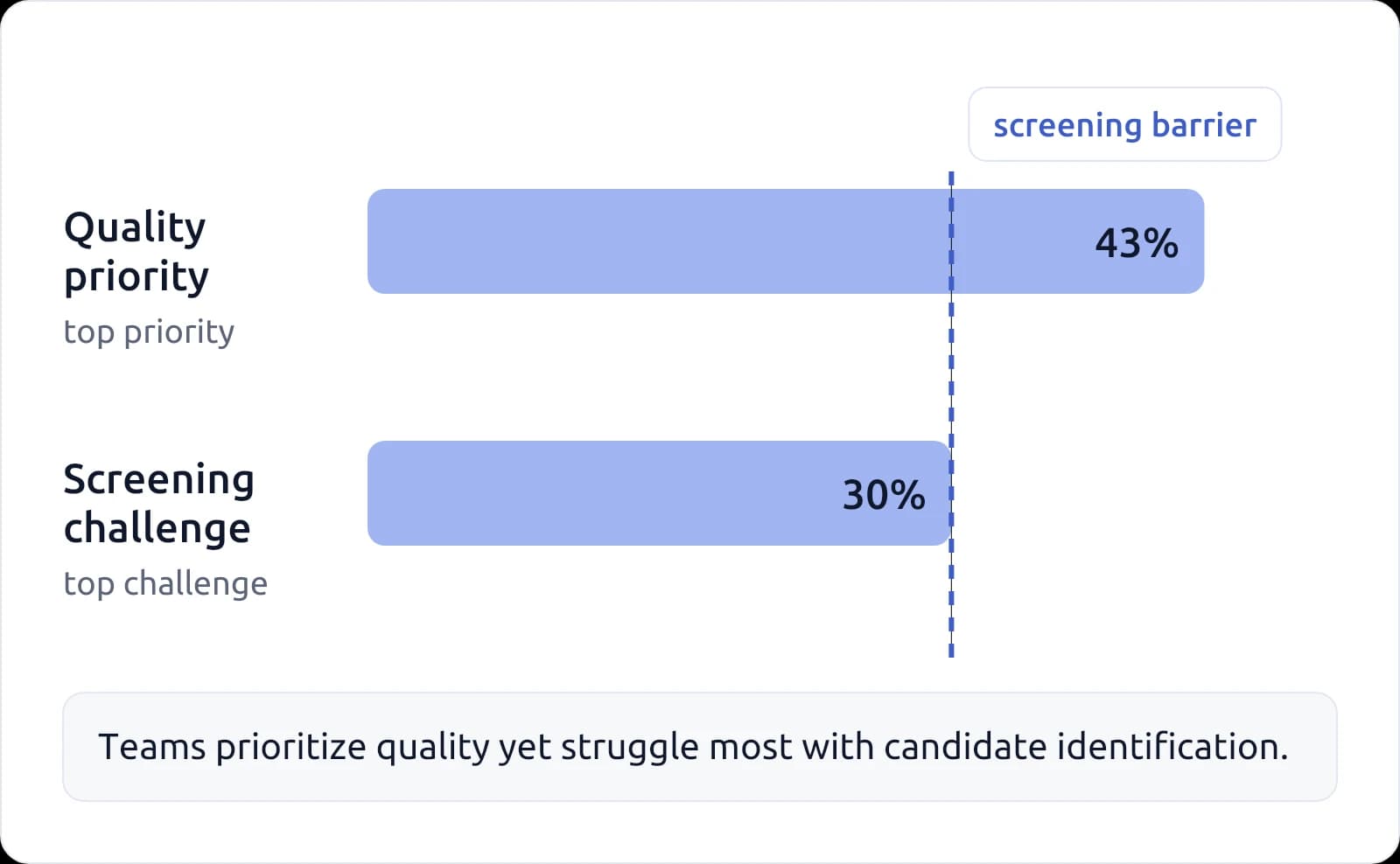
Recruiting leaders face clear operational pressures. Industry reports reveal that improving candidate quality is the primary goal for 43% of teams, while identifying qualified talent represents the top operational barrier for 30%. Efficiency metrics matter, but speed alone cannot show whether a candidate delivers on the job. Measurements like time-to-fill or cost-per-hire track recruitment efficiency, but speed metrics do not indicate whether a new employee helps the business meet its goals. Useful quality evaluations depend on post-hire inputs such as turnover rates, job performance, and 360-degree ratings.
A reliable quality measurement requires patience and structured data. Rather than pulling a single number from an ATS, teams must treat the metric as a composite score of several post-hire indicators gathered across multiple quarters. Without objective scorecards, recruiters inadvertently reward formatted resumes over verified execution.
how does ai candidate matching differ from basic ats keyword searches?
Keyword filters match isolated words regardless of context, which allows inflated applications to slip through. Neural AI matching evaluates the depth of candidate achievements, career progression, and proven skill applications across entire employment histories. This distinction prevents unqualified candidates from gaming screening filters with modern generative text tools.
Legacy applicant tracking systems rely on simple string searches. If an applicant adds specific acronyms into a skills section, the system ranks them high. Modern AI matching reads work histories contextually to verify whether that skill drove measurable business outcomes. You can rank candidates by fit by analyzing real project scopes rather than surface phrases.
| Screening feature | Legacy ATS filter | Neural AI matching |
|---|---|---|
| Core evaluation method | Exact keyword and phrase counts | Semantic understanding of career achievements |
| Defense against resume inflation | Poor; vulnerable to hidden text and buzzwords | High; verifies context, tenure, and scope |
| Scoring clarity | Arbitrary percentage based on keyword density | Structured scorecards with clear match reasoning |
| Rejection handling | Silent discards with no qualitative audit trail | Documented evidence logs for each candidate |
how can teams build a composite quality of hire score?
Teams build a composite quality of hire score by combining pre-hire assessment data with post-hire performance indicators into a weighted mathematical index. This approach balances initial interview expectations against actual workplace results. Combining multiple inputs avoids relying on single subjective manager opinions.
To evaluate overall recruiting effectiveness, leaders can average individual hire scores and factor in turnover. This baseline shows whether initial interview rubrics match actual job performance.
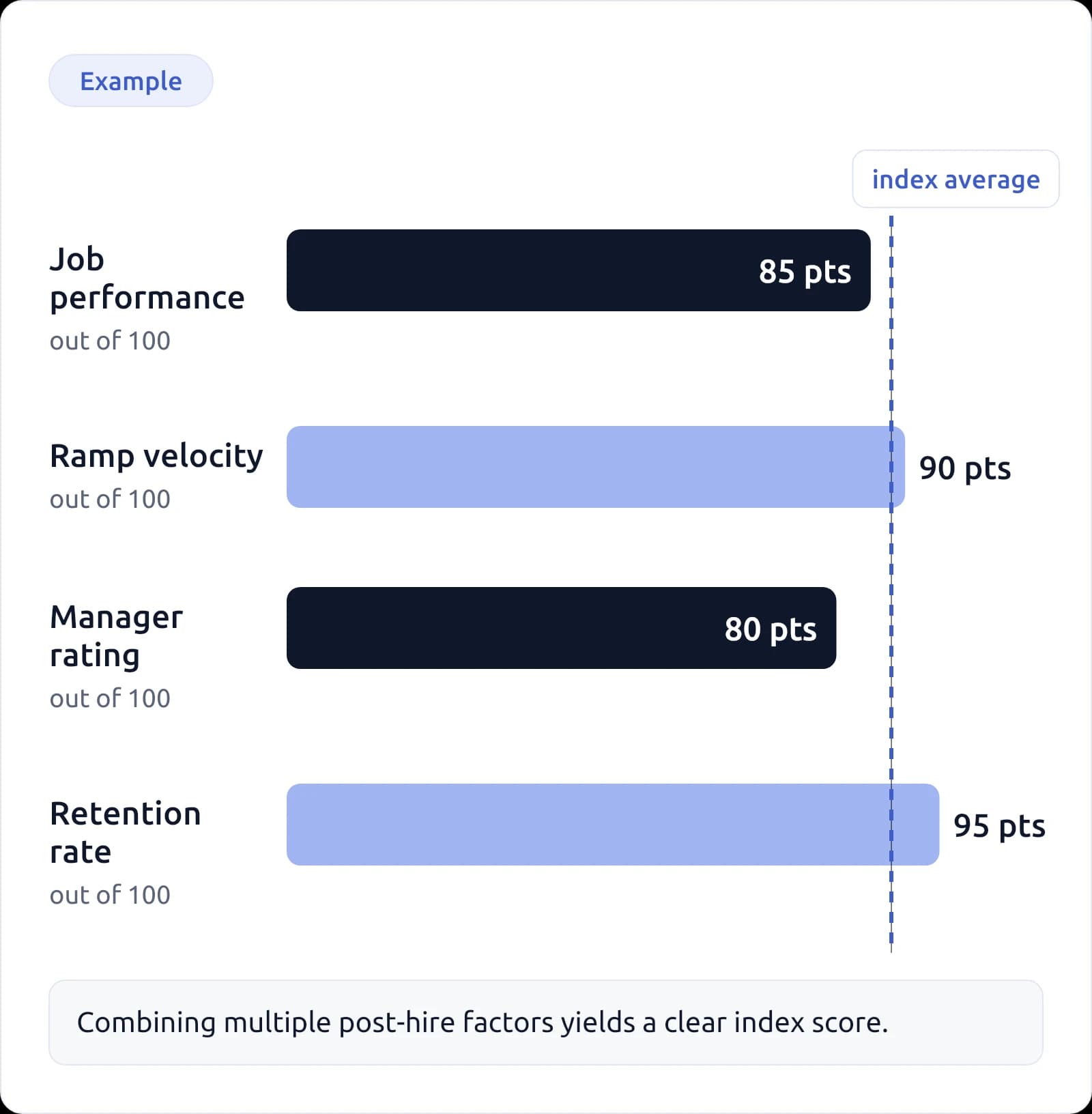
A hiring team tracks core post-hire indicators such as manager ratings, milestone speed, cultural reviews, and retention status. Teams assign practical weights to each metric, such as forty percent to manager reviews and thirty percent to ramp speed, to calculate an objective score. Averaging these scores gives recruiters an objective baseline for hiring quality across the entire cohort.
how do you connect 90-day post-hire data back into recruitment?
Connecting post-hire data into recruitment requires establishing a structured feedback loop that updates top-of-funnel screening rules based on manager reviews. When teams log job outcomes over time, AI agents adjust candidate qualification weightings for future searches. Hiring managers use these evidence-based updates to make final candidate selections with confidence.
- Collect standardized 90-day performance reviews focusing on core skill execution, ramp time, and team collaboration.
- Compare these performance ratings against the initial candidate scorecards to identify which pre-hire signals correlated with high job success.
- Update your initial sourcing rubrics to prioritize the specific backgrounds and problem-solving styles exhibited by top performers.
- Remove legacy screening criteria that showed no correlation with positive on-the-job outcomes.
- Run continuous updates so your recruitment pipeline adapts as internal role requirements shift.
Teams that connect post-hire data directly to screening rules cut down on repeat hiring mistakes. Recruiter calibration improves every quarter because the screening model learns from actual workplace performance.
how recruiters maintain final authority in an automated pipeline
AI systems process volume, rank profiles, and surface contextual evidence, but human hiring managers retain sole authority over final hiring decisions. AI handles early filtering so recruiters can dedicate their hours to assessing interpersonal strengths, career ambitions, and team cohesion.
Delegating administrative discovery to automation protects recruiters from screening fatigue. When software surfaces the best prospects with documented reasoning, hiring panels can focus on deep conversations rather than sorting resumes. This division of responsibility ensures every candidate receives a fair review while keeping accountability in human hands.
| Pipeline phase | AI agent role | Human recruiter role |
|---|---|---|
| Profile sourcing | Scans multiple networks to identify matched profiles | Approves role parameters and candidate targets |
| Initial resume review | Analyzes achievements and generates fit scorecards | Validates match evidence and selects interviewees |
| Screening assessment | Collects responses and flags missing qualifications | Conducts dynamic conversations and probes gaps |
| Final hiring decision | Provides consolidated performance records | Evaluates interpersonal fit and extends offers |
how scrini ai helps teams identify qualified talent
Scrini AI automates early pipeline workflows by scoring and ranking talent based on user-defined criteria. The platform automates first-round sourcing across external talent networks while recruiters manage candidate communication. Most teams are live within 24 to 48 hours with ATS integration and guided onboarding included at no extra cost.
The platform scores and ranks every candidate automatically while logging match reasoning to give human recruiters a clear audit trail. Teams can source candidates on autopilot across LinkedIn, public job boards, and internal databases without managing complex manual searches. You define role requirements once, and the agent ranks candidates against project scope, tenure, and verified technical outcomes.
The platform operates on a usage-credit model with no per-seat fees, charging only for completed candidate workflows. The Startup plan begins with 100 free credits with no card needed. Teams can then purchase additional credits for US$0.10 each on the Startup plan.
frequently asked questions
can ai predict candidate job performance accurately?
AI predicts potential job performance by identifying past patterns of achievement and project complexity rather than reading raw resume keywords. It matches candidate experience to specific job requirements. However, human interviewers must always evaluate soft skills, work ethic, and team collaboration during live interviews before making offers.
does using ai in hiring create legal compliance issues?
Teams should ensure AI software provides transparent reasoning for candidate rankings and avoids using protected demographic classes. The platform maintains an audit trail explaining why candidates match specific requirements. Human hiring teams review these scorecards and make all final employment decisions.
how does ai handle candidates with non-traditional backgrounds?
AI identifies transferable skills by evaluating core project accomplishments instead of requiring specific university degrees or linear job titles. It connects related industry experiences to open job duties, helping recruiters discover qualified candidates whose unconventional career paths might otherwise get missed by rigid manual keyword filters.
next steps for your team this week
Audit your quality of hire process this week by reviewing your last five hires. Compare their original interview scorecards against their 90-day manager reviews. Note any discrepancies between their resume claims and their actual job output. Use these insights to refine your next role intake rubric and focus screening criteria on verified work samples.