


 ScriniAI agents that hire for every role
 Job seekers
 Recruiters
Ethical AI in recruitment: compliance and audit guide
A practical compliance and procurement framework for ethical AI in recruitment, covering EU AI Act High-Risk standards, vendor bias audits, and human-in-the-loop workflows.

Ethical AI in recruitment requires verifiable technical controls, clear candidate notices, and documented human oversight rather than blind trust in algorithms. AI agents screen candidate pipelines in minutes, but human hiring managers retain final hiring authority. Meeting global compliance standards means establishing structured audit checklists and standard operating procedures before deploying automated systems.
Key takeaways
- Treat recruitment algorithms as high-risk systems subject to mandatory human oversight and audit trails.
- Require software vendors to provide independent bias audit data and training data demographic distributions before procurement.
- Establish standard operating procedures that prevent recruiter automation bias and enforce human review on borderline scores.
- Notify candidates in advance about automated screening and provide clear dispute and opt-out pathways.
How does the EU AI Act regulate hiring software?
Treat recruitment and candidate evaluation tools as high-risk systems subject to strict standards. This classification requires employers to maintain human oversight, log system activity, and ensure data governance. The goal is to prevent systems from infringing on fundamental rights during screening, ranking, and task evaluations.
Under Article 14, human oversight must prevent or minimise risks to candidate fundamental rights during automated hiring. AI agents can manage repetitive first-round pipeline tasks, but humans must retain the power to intervene or reverse recommendations. Regulators recognize that unchecked automation presents real risks during resume filtering and candidate scoring.
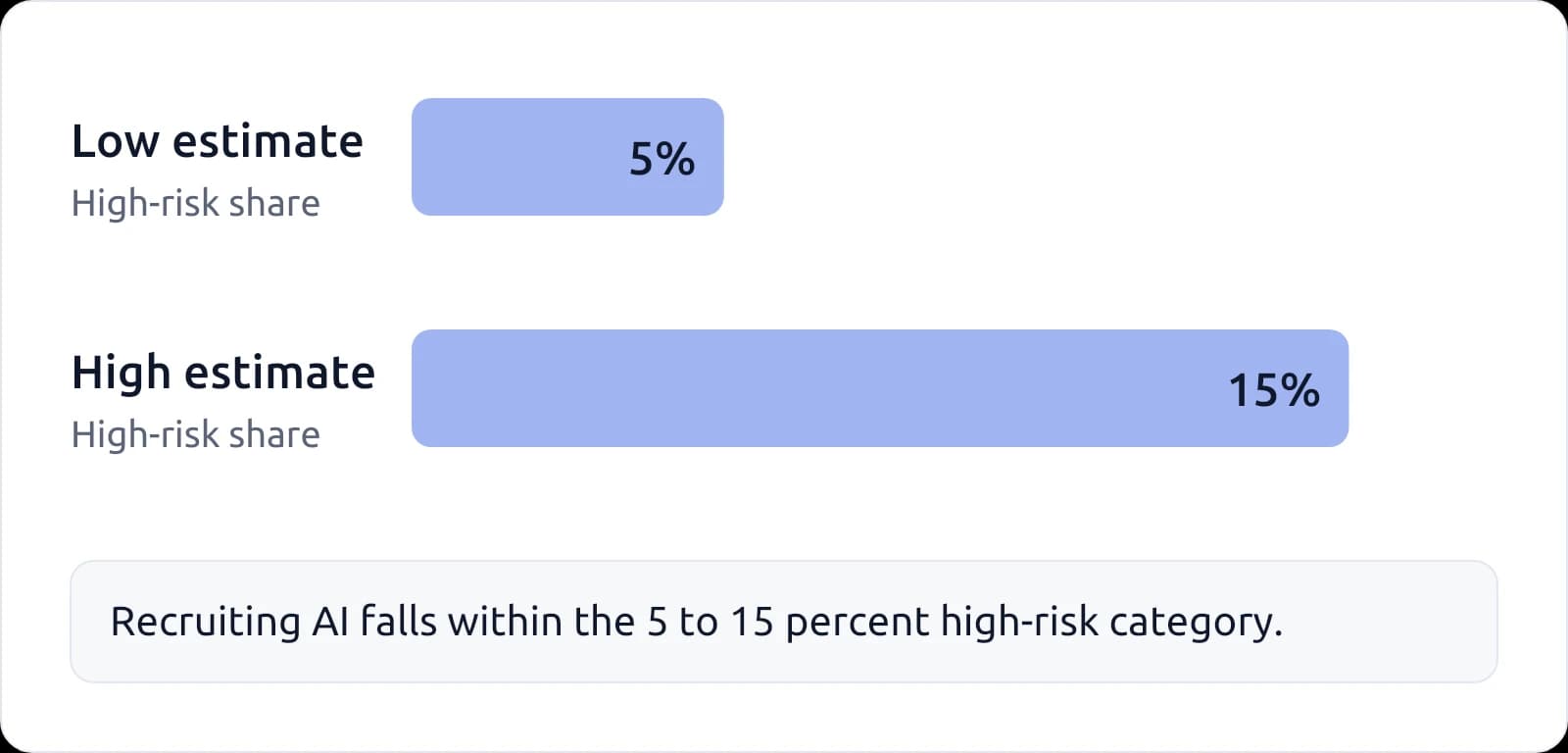
The European Commission has estimated that 5 to 15 percent of AI systems on the EU market fall into the high-risk category. For systems classified under Annex III, enforcement begins on 2 December 2027 under Article 113(c). Talent teams should prepare now by mapping data pipelines, reviewing automated scoring mechanisms, and implementing compliance built into every hire.
What vendor procurement checks ensure ethical AI?
Procurement checks for ethical AI require verifying third-party bias audits, confirming data privacy safeguards, and validating candidate transparency notices. Employers remain legally accountable for unlawful discrimination caused by algorithmic selection tools. Talent leaders must review vendor documentation to confirm systems meet regulatory standards before signing contracts.
When procuring hiring software, talent acquisition teams must inspect training data demographic distributions. In jurisdictions like New York City, employers must ensure tools undergo an independent bias audit within one year prior to use. Require vendors to provide these audit summaries and demonstrate how their models prevent disparate impact across protected groups.
Operational checks also require completing a data protection impact assessment to review how candidate personal data is stored and processed. Regulations also state that employers should clearly signpost AI systems to applicants before deployment. The following checklist details the core criteria teams should require during procurement.
| Evaluation Area | Compliance Requirement | Verification Evidence |
|---|---|---|
| Algorithmic Bias | Annual external audit verifying fair selection rates | Published bias audit summary no more than 1 year old |
| Human Oversight | Recruiter ability to inspect scores and override decisions | Audit trail recording overrides and manual reviews |
| Data Privacy | Data minimization and secure handling of candidate data | Completed Data Protection Impact Assessment (DPIA) |
| Candidate Transparency | Clear notice of automated screening prior to evaluation | Written candidate disclosure with opt-out mechanisms |
How can teams reduce recruiter automation bias?
Teams limit recruiter automation bias by replacing blind acceptance of percentage scores with structured, evidence-based candidate scorecards. Regulators define automation bias as the tendency to over-rely on automated outputs. Providing recruiters with transparent criteria, skill test data, and documented review protocols keeps human judgment central to hiring decisions.
Article 14 of the EU AI Act explicitly addresses the risk of automation bias where staff demonstrate a "tendency of automatically relying or over-relying" on algorithmic outputs. When software outputs a single percentage match, recruiters often discard candidates without verifying the underlying reasons. True oversight demands that software displays the specific evidence behind an evaluation.
To keep humans firmly in control, talent teams must build review routines into daily workflows. Recruiters should verify work samples, structured responses, and verified credentials rather than trusting summary labels. You can shortlist with evidence by enforcing standard operating procedures that mandate second-look reviews for candidates who fall just outside qualifying thresholds.
Standard operating procedure for score overrides: worked example
A standard operating procedure for score overrides defines when and how recruiters must manually evaluate borderline candidates. Automated agents process repetitive initial assessments, but humans review scoring anomalies and make final shortlist selections. This documented protocol prevents automated false negatives and maintains clear audit logs for hiring compliance.
A hiring team sets an automated screening cutoff for an engineering role, flagging applicants who score just below the threshold for mandatory human review. When an applicant misses the cutoff because the system overlooks an equivalent open-source framework in their portfolio, a recruiter steps in. The recruiter checks the repository, confirms the relevant experience, and manually raises the score. A short note in the candidate profile explains the decision before advancing them to the interview stage.
Evidence-backed compliance with Scrini AI
Scrini AI supports regulatory compliance by recording verifiable evidence for every candidate interaction, scoring event, and recruiter override. AI agents manage initial multi-channel outreach and repetitive screening tasks, while human recruiters retain complete control over hiring decisions. Organizations maintain auditable hiring records through usage credits without recurring seat licenses.
Our platform generates evidence-based scorecards based on employer role requirements and actual candidate responses. Recruiters inspect exact work samples and written answers, ensuring people stay in charge of final hiring choices. Every touchpoint, evaluation, and manual adjustment is captured in exportable logs supporting independent bias audits.
There are no per-seat fees or recurring license overheads. You can review our full AI transparency notice to see how our architecture supports compliant, auditable hiring workflows.
Frequently asked questions
What defines ethical AI in recruitment?
Ethical AI in recruitment requires transparent screening criteria, independent bias audits, advance candidate notification, and continuous human oversight. Algorithmic tools should handle repetitive administrative workflows while human recruiters evaluate nuanced qualifications. Maintaining verifiable audit trails ensures hiring decisions remain fair, explainable, and compliant with global employment regulations.
Who holds legal responsibility for algorithmic discrimination?
Employers remain legally responsible for discriminatory hiring outcomes even when using third-party algorithmic software. Purchasing an external screening tool does not transfer legal liability away from the hiring organization. Talent leaders must review vendor compliance documentation and audit reports before deploying automated evaluation tools.
What is an independent bias audit for recruitment AI?
An independent bias audit is an external statistical evaluation that checks whether an automated hiring tool produces disparate impact across protected demographic groups. Qualified independent auditors calculate selection rates and impact ratios. Talent teams should aim to complete and review bias audit results on an annual basis.
What candidate disclosures are required for hiring software?
Employers must inform applicants in advance that an automated tool evaluates their resume or assessment submissions. Notices should clearly outline the job qualifications being measured, the assessment timeline, and applicant privacy rights. Organizations must also provide clear instructions for requesting reasonable accommodations or alternative non-automated assessment pathways.
Next steps for your hiring pipeline
Review your candidate-facing notices this week to verify that applicants receive clear disclosure before any automated screening takes place. Request the most recent independent bias audit reports from your hiring software vendors, ensuring all assessments were completed within the past year. Update internal score override procedures so recruiters document manual reviews for every borderline candidate.