


 ScriniAI agents that hire for every role
 Job seekers
 Recruiters
combating ai candidate fraud
Hiring teams face synthetic applicants and proxy interviewers. Here is how to verify remote candidate authenticity without relying on flawed AI text detectors.

Combating AI candidate fraud requires continuous identity verification and live, adaptive evaluation rather than flawed AI text detectors. Modern hiring fraud spans synthetic profiles, proxy interviewers, and real-time audio copilots. Teams protect their pipeline by validating identity across every funnel stage while human hiring managers make all final employment decisions.
Key takeaways
- Replace text detectors with continuous identity proofing across application, assessment, and interview stages.
- Use Socratic questioning and past project post-mortems during live screens to neutralize real-time AI copilots.
- Publish an explicit candidate AI policy that separates basic drafting tools from deceptive assistance.
- Comply with state biometric privacy statutes by securing candidate consent before running video or liveness analysis.
How do candidates use AI to commit interview fraud?
Candidates commit interview fraud using generative tools to manufacture synthetic resumes, clone audio feeds, and feed live interview questions to background copilots. These tools let unqualified applicants pass remote screens through secret external help. While automated tools distort paper credentials, real-time deceptive assistance poses the primary operational risk during remote interviews.
Resume inflation is not new, but generative text tools allow applicants to build fabricated career histories in minutes. During virtual screenings, candidates often take deception further. Some recruit third-party proxies who lip-sync during video calls, while others use invisible browser extensions that transcribe questions and feed answers in real time.
Research shows that 35% of hiring managers have seen candidates use AI during interviews to generate responses. Basic spell-checking or resume formatting presents little risk to hiring integrity. Real problems arise when applicants use automated prompters to fake technical competence or hire proxies to stand in during technical evaluations. Teams must learn how to detect AI resumes without flawed detector tools while establishing live operational checks.
Why do AI text detectors fail to stop synthetic resumes?
Automated text classifiers fail to stop synthetic resumes because they rely on predictable word sequences rather than actual factual verification. These tools produce high rates of false positives and regularly flag authentic content from qualified applicants. Relying on automated detectors creates severe legal exposure and turns strong candidates away without verifying technical ability.
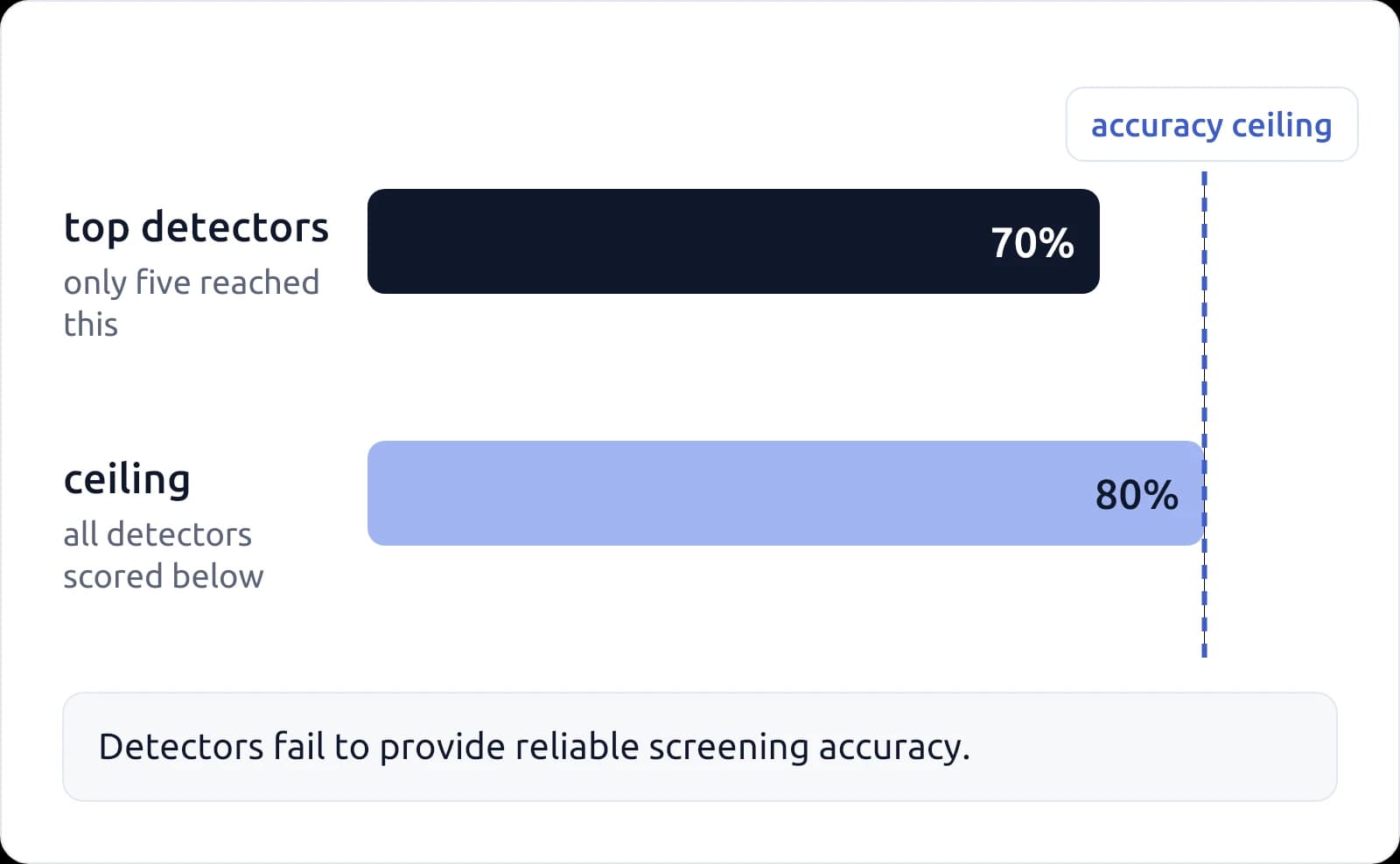
Text classifiers look for perplexity and burstiness. When a candidate writes in a clean, formal style, software often flags the text as machine-generated. In an evaluation of automated detection tools by Weber-Wulff et al., fourteen tested detectors were neither accurate nor reliable, with all scoring below 80% accuracy and only five scoring above 70%.
These tools present severe fairness issues. Non-native English speakers frequently use standard grammatical patterns that trigger false alarms. Rejecting candidates based on probabilistic text scoring exposes companies to compliance risks while failing to catch sophisticated bad actors who alter their wording. Instead of parsing text with statistical guesswork, recruiters should use a structured interview playbook that tests real-world problem solving.
How do you verify candidate identity across the funnel?
Verifying candidate identity across the funnel requires multi-point confirmation rather than a single check at the start. Fraudulent candidates often submit legitimate credentials, send a proxy to the technical screen, and appear personally only for onboarding. Continuous verification confirms that the person assessed is the person hired while humans make final selections.
Federal identity guidelines provide a practical blueprint for remote hiring. The NIST SP 800-63 digital identity framework outlines risk assessment methods and authenticators to establish confidence in applicant identity. Specifically, NIST SP 800-63A sets enrollment and identity proofing requirements across three distinct identity assurance levels, whether remotely or in person.
A structured hiring workflow binds candidate credentials to work samples and live sessions. By checking identity at each handoff, teams stop proxy handoffs early.
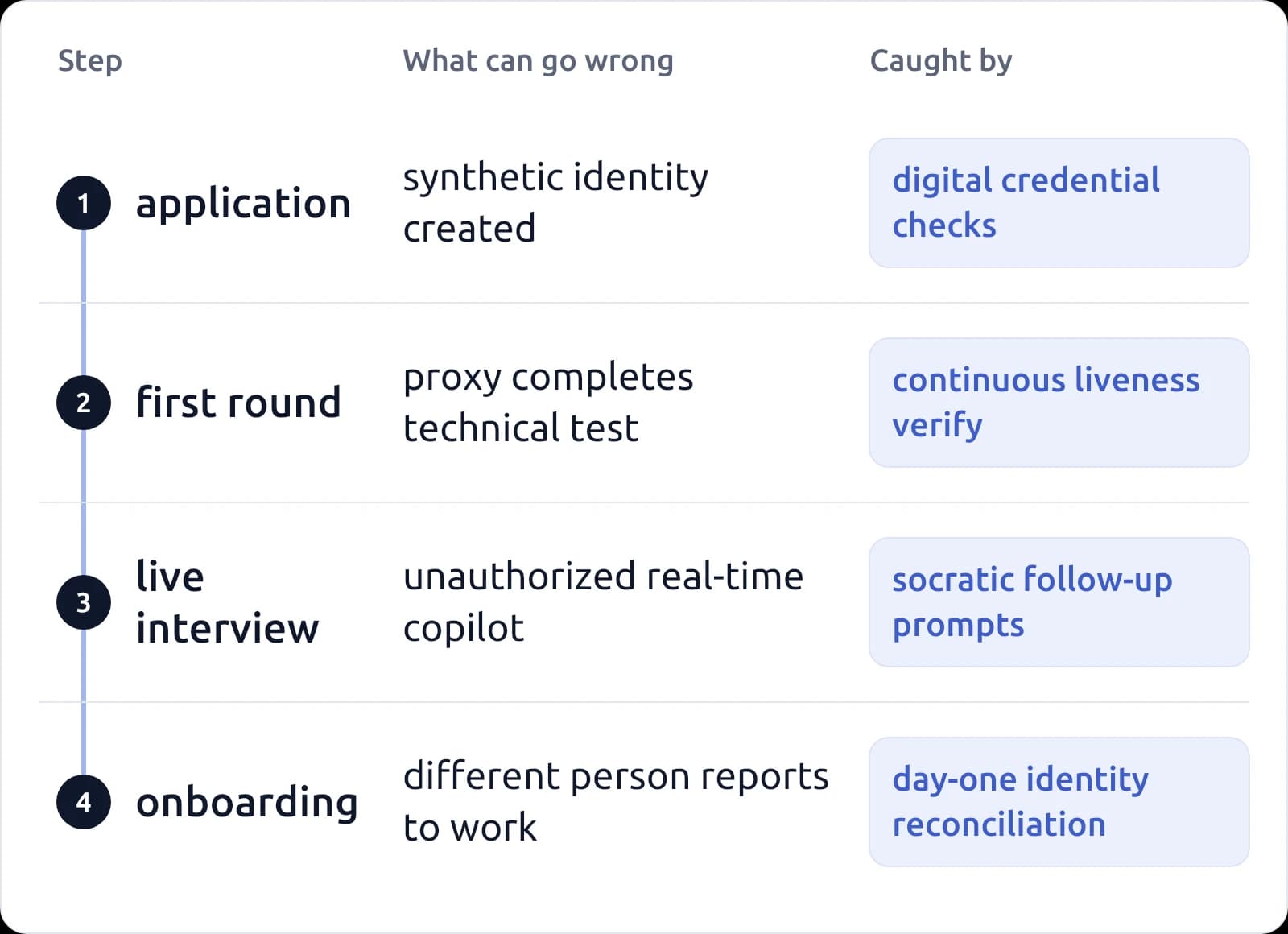
| Funnel stage | Primary fraud risk | Verification safeguard | Decision authority |
|---|---|---|---|
| Application | Synthetic experience and fabricated work history | Asynchronous verification and cross-referenced public records | Automated pre-screen |
| Skills screen | Proxy test-taker or external script assistance | Browser lockdown and continuous webcam verification | Recruiter with AI scorecard |
| Live interview | Audio copilots and real-time teleprompters | Socratic probing and dynamic constraint adjustments | Human interviewer |
| Offer and onboarding | Identity swapping between interview and start date | Government ID check matched against interview records | Hiring manager and HR |
How to detect real-time AI copilots during live interviews?
Detecting real-time AI copilots requires conversational interview techniques that disrupt teleprompters and hidden audio feeds. Scripted prompts fail when candidates must answer rapid, branching follow-ups about actual project execution. Socratic questioning exposes whether an applicant truly understands the technical trade-offs or is simply reading machine-generated text from a second monitor.
Candidates using real-time assistance typically display clear physical tells. They pause unnaturally after simple questions, glance away from the camera while waiting for latency-heavy transcripts, and deliver polished, abstract responses that lack personal anecdotes. When pressed for specific implementation details, their fluency drops sharply.
Interviewers should abandon standard trivia questions that generative models answer effortlessly. Ask the candidate to critique a flawed architecture diagram on the fly or explain a time an unexpected production bug forced them to roll back a release. Introduce changing requirements halfway through a coding exercise. Human evaluators retain complete authority over hiring decisions, using live observations to evaluate depth of competence.
What should a compliant candidate AI policy include?
A compliant candidate AI policy must define acceptable tool usage, establish clear disclosure requirements, and secure informed consent before any automated evaluation occurs. Transparent guidelines prevent misunderstandings between candidates and recruiters while maintaining strict adherence to employment regulations. Clear rules protect candidate rights and establish consistent expectations across every screening stage.
State laws increasingly govern automated assessments in recruitment. In Illinois, rules in force since January 1, 2020 require employers to explain the characteristics evaluated before an interview begins. Employers must also obtain candidate consent before the interview and cannot evaluate applicants who decline.
Your policy should distinguish between acceptable drafting aids, like grammar checkers, and prohibited real-time proxy tools. Ensure your evaluation criteria never screen or score applicants based on protected characteristics like race, sex, age, religion, or national origin. Publish your standards within your candidate portal and link them directly to an Acceptable Use Policy prohibiting screening or scoring candidates on protected characteristics.
Worked example of multi-stage identity verification
Structured identity checkpoints prevent proxy candidates from slipping into final interview rounds without creating friction for legitimate applicants. By validating candidate credentials progressively across four pipeline stages, talent teams identify discrepancies before committing executive time. This phased approach maintains hiring velocity while protecting the organization from synthetic credentials and proxy interviewers.
Consider a software firm evaluating 100 applicants for a remote infrastructure role. During the initial application review, automated parsing flags 15 profiles with conflicting credential histories for manual recruiter inspection. The remaining 85 candidates receive an invitation to an asynchronous technical assessment with identity confirmation.
A portion of suspicious applicants abandon the process when prompted for ID verification, while verified candidates complete the assessment within hours. During the subsequent live technical screen, continuous identity matching flags suspicious proxy attempts where a video profile does not match earlier assessment data. Human hiring managers review the evidence logs, confirm discrepancies, and remove flagged individuals from consideration. Cleared candidates advance to conversational team interviews, cutting recruiter screening hours while keeping the funnel secure.
How Scrini AI maintains assessment integrity
Automated hiring platforms must protect assessment integrity without slowing down qualified candidates or compromising data privacy. Through continuous monitoring and secure verification checkpoints, hiring teams identify deceptive behavior before making offer decisions. AI agents manage repetitive verification tasks, leaving final evaluation and hiring decisions in the hands of human managers.
The platform provides Liveness Verify, running continuously during virtual assessments to confirm candidate identity without disrupting the test experience. Built-in deepfake and proxy detection flags suspicious video or audio manipulation in remote interviews. Security controls map directly to SOC 2 requirements, masking applicant identifiers on-device to protect personal information. Recruiter dashboards generate evidence-based scorecards and timestamped notes so hiring managers make fast, objective hiring decisions.
Scrini AI offers a credit-based Startup plan. Teams pay only for completed work, with no per-seat fees. The Startup plan starts with 100 free credits with no card needed, and additional credits cost US$0.10 each.
Frequently asked questions
What is the most reliable strategy for combating AI candidate fraud?
The most reliable strategy combines continuous identity verification across all hiring stages with dynamic, Socratic live interviews. Rather than relying on inaccurate text detectors, teams confirm physical identity from application to offer. Live conversational probing reveals whether an applicant understands practical constraints, while human hiring managers make all final employment decisions.
Why do automated AI text detectors fail during resume screening?
Automated text detectors fail because they evaluate predictable phrasing rather than factual accuracy or candidate capability. They generate frequent false positives that unfairly penalize non-native English speakers who use formal language. Because detectors cannot verify past accomplishments, teams should evaluate real-world work samples instead of probabilistic text scores.
How can interviewers tell if a candidate is using a real-time copilot?
Interviewers spot real-time copilots by noticing audio latency, unnatural pauses, eye movements toward secondary screens, and generic textbook answers. When asked dynamic follow-up questions about unexpected system constraints or trade-offs, copilot users struggle to adapt. Socratic questioning exposes whether an applicant has genuine hands-on expertise or is reading answers.
What legal disclosures are required when using AI to screen candidates?
Legal disclosures require notifying candidates before evaluation about how the automated system works and which characteristics it evaluates. Certain jurisdictions, including Illinois, mandate obtaining explicit applicant consent prior to running AI evaluations. Hiring systems must never screen, score, or reject applicants based on protected characteristics like race, age, or sex.
Next steps for your hiring pipeline
Update your hiring workflow this week by auditing your technical screening stages. Review your candidate communications to add an explicit policy regarding acceptable AI tools and disclosure expectations. Replace standard text detectors with adaptive, scenario-based questions that test real problem-solving capabilities. Finally, introduce continuous identity verification into your remote interviews so your hiring managers evaluate genuine, qualified talent.